
...and a news article relating to the snow.
Friday, January 11, 2008
Winter wonderland
I woke up this morning, opened the door, and my jaw hit the floor. HUGE white snowflakes were drifting down out of the gray Baghdad skies. All the Iraqis we're talking to are saying that this is the first time in living memory that it has snowed in Baghdad. Sleet in winter is not so uncommon, but never snow. I'll resist cracking-wise about global warming, but perhaps it is time to sit back, take stock, and mull over the profound implications of the fact that... Hell has indeed frozen over!


Thursday, January 10, 2008
For the children
A little project we'd been working on for two months has finally been hand-held through to completion. Two months ago while engaged in an email exchange with a radio station back home on an entirely different subject, the folks there asked if there was anything they could do to for us to express their support. It immediately brought to mind a school we had recently visited packed with 4-6 year olds with absolutely no toys to play with, and teachers with no supplies with which to occupy their charges. This is largely a function of dramatically uneven distribution of resources by Iraq's Ministry of Education. Some schools are well supplied, some are entirely neglected. This one was of the latter category. The school also happened to be located less than a block from one of our JSSs (Joint Security Station). To that end, I told the folks at the radio station that we, as soldiers, lacked for nothing. However, if they saw fit to coordinate a toy drive to support this school, well... I could think of nothing that would be appreciated more, both by the soldiers, and the Iraqi people. So began a journey that involved several businesses from back home, and hundreds of ordinary people who went out of their way to make a small gesture of support and affection. The cumulative effect of that effort was realized this week when we loaded up a convoy of humvees and delivered the toys to the school.
The radio station posted the photos from the drive on their website HERE.
Furthermore, HERE is a link to a recording of a call-in interview I did with the outstanding folks at the radio station in the days following.
The radio station posted the photos from the drive on their website HERE.
Furthermore, HERE is a link to a recording of a call-in interview I did with the outstanding folks at the radio station in the days following.
Tuesday, December 25, 2007
US...O...nevermind
It was billed as a star-studded USO entertainment tour for armed forces on the ground. For the first part of our tour we were stationed at the periphery of the war; a nasty little base known best for being the Southern point of the "Sunni Triangle", a.k.a. "Triangle of Death". No USO shows made it out to those nether-regions. After we moved to Baghdad, we were essentially too tired from a high mission tempo, or too busy to pay much attention to any of the shows that passed through. With this in mind, and with our schedule open, Bob and I decided that we would at last take advantage of the opportunity to put a good, ol' fashioned USO show under our belts at the end of our tour of duty. The show was to feature Robin Williams, Kid Rock, Lance Armstrong, and several others. We headed over to the Division field house where the meet-and-greet was to take place. We arrived a full hour and forty-five minutes early to ensure ourselves a seat, and there was already a substantial line. While we waited, the temperature dropped, and the line rapidly lengthened. We estimated that by the time they opened the doors, there were approximately 3,000 persons in line for a venue that was going to be limited to 600 persons.
 Rumors started to move through the crowd even before we entered the building. Once inside, they were confirmed. High winds in Tikrit had grounded the helicopters, and the show was canceled. Instead, we were greeted to a ten minute "pep talk" by the Chairman of the Joint Chiefs of Staff, Admiral Mullen, who reassured us that he received briefings on what was going on in Iraq. Really. He then proceeded to distribute commemorative coins, shake hands, and have his photo snapped with anybody who wished it. Bob and I received coins, but we were rushed through so rapidly, that we were unable to get photos with the Admiral.
While we were waiting in line, I scanned the crowd and it occurred to me that these USO concerts probably are not attended by the soldiers for whom they are largely intended. The soldiers doing the heavy-lifting in this war are the guys stationed away from the big bases. They're quartered out in the neighborhoods in converted office building, houses, or police stations. They make it back to base maybe one day out of the week. Instead, those attending these "moral-boosting" functions appeared to be largely the "fobbits"; those with desk jobs, Air Force personnel, and others who otherwise almost never make it outside the wire. A significant percentage of the crowd was also civilians; handsomely compensated KBR employees and contractors. We stood in line next to a group of these guys who loudly compared the quality of many of the USO shows and celebrities they'd had occasion to see over the past year.
 It is now Christmas day. The dining facilities on base are packed with soldiers taking advantage of an extravagant Christmas dinner with all the trimmings. Rather than deal with the huge lines, our detachment opted to ante up, and one of our interpreters arranged to bring in a positively massive authentic Iraqi feast from one of Baghdad's finer restaurants. The quantity and variety of delectables was mind-boggling. All manner of meats and vegetables, rice, soups, sauces, and breads, were followed by a selection of sweet desserts. It was enough, even for a short while, to relieve the ache of being so far from home and loved ones.
Merry Christmas from Baghdad.
 Rumors started to move through the crowd even before we entered the building. Once inside, they were confirmed. High winds in Tikrit had grounded the helicopters, and the show was canceled. Instead, we were greeted to a ten minute "pep talk" by the Chairman of the Joint Chiefs of Staff, Admiral Mullen, who reassured us that he received briefings on what was going on in Iraq. Really. He then proceeded to distribute commemorative coins, shake hands, and have his photo snapped with anybody who wished it. Bob and I received coins, but we were rushed through so rapidly, that we were unable to get photos with the Admiral.
While we were waiting in line, I scanned the crowd and it occurred to me that these USO concerts probably are not attended by the soldiers for whom they are largely intended. The soldiers doing the heavy-lifting in this war are the guys stationed away from the big bases. They're quartered out in the neighborhoods in converted office building, houses, or police stations. They make it back to base maybe one day out of the week. Instead, those attending these "moral-boosting" functions appeared to be largely the "fobbits"; those with desk jobs, Air Force personnel, and others who otherwise almost never make it outside the wire. A significant percentage of the crowd was also civilians; handsomely compensated KBR employees and contractors. We stood in line next to a group of these guys who loudly compared the quality of many of the USO shows and celebrities they'd had occasion to see over the past year.
 It is now Christmas day. The dining facilities on base are packed with soldiers taking advantage of an extravagant Christmas dinner with all the trimmings. Rather than deal with the huge lines, our detachment opted to ante up, and one of our interpreters arranged to bring in a positively massive authentic Iraqi feast from one of Baghdad's finer restaurants. The quantity and variety of delectables was mind-boggling. All manner of meats and vegetables, rice, soups, sauces, and breads, were followed by a selection of sweet desserts. It was enough, even for a short while, to relieve the ache of being so far from home and loved ones.
Merry Christmas from Baghdad.
Wednesday, December 12, 2007
Something wicked this way comes
 Some new mechanical monsters are crawling through Baghdad's streets these days. They are MRAP (Mine Resistant Ambush Protected) vehicles. The medium sized US Army version began arriving a month or so ago, and units have gradually been getting trained up on them. Troop reaction has been mixed. My first reaction upon seeing them lined up outside our battalion headquarters was that these things are really going to irritate the Iraqis! The base vehicle is really tall. But when you add a turret, and all of the antennae required by the schmorgasboard of communications and anti-IED electronics, well... the gunner damn near performs the function of close air support! Here are some of the problems as I see it. First, most of Baghdad operates on power generated by local private, or neighborhood, generators rather than the cities power grid. This means that a large generator parked on a street corner will have hundreds of wires strung from it like a spider web feeding homes and businesses in the area. As the ability of the city to provide power ebbed, this chaotic overhead wiring began to blanket the city like a great, multi-colored cobweb. We routinely snag one or two of these low-hanging wires with our vehicle antennas when we drive through neighborhoods. They snap, and eventually somebody will have to come out and restring the wire. (We've also had guys electrocuted by these wires, and had equipment snagged that became dislodged from the vehicle and injured soldiers.) In most neighborhoods, the residents eventually began to accommodate the humvees by elevating the wiring beyond the reach of the antenna. However, now with the introduction of the MRAP, a huge percentage of the wire that feeds electricity to Baghdad's homes and business is now at risk once again. We recently did a patrol composed of one humvee (that would be us) and three MRAP's. We watched in awe as the vehicle in front of us took down strand after strand after strand of the wires strung over the streets. People on the sidewalks had to be particularly alert as cables snapped towards them like angry bullwhips. Not the most effective way to win hearts and minds!
 Second, there is the psychological impact of having these monstrosities rolling through neighborhoods. There is no question that these are significantly more resistant to IED attack. However, one of the most effective components of the current counter-insurgency strategy is the integration with the communities we're tasked with protecting. This means, getting to know the people, developing relationships, and learning the proverbial pulse of the neighborhood. Rolling around in armored humvees makes achieving this level of intimacy difficult enough. (I personally would prefer greater emphasis on dismounted foot patrols.) But, moving from humvees to MRAP's, from a psychological point of view, only serves to distance us further from the population, and it comes at a time when the number if IED attacks against us appears to be nearing an all-time low.
Lastly, another drawback relating to the height of these beasts is the propensity of the crew to misjudge the distance to the ground when they dismount the vehicle. Burdened by armor, weapons and gear, we've seen numerous broken ankles and other injuries simply from getting in and out of the vehicles.
That said, not all units are using the MRAP's they've been issued. Some commanders are opting to just keep them on the property books and turn them over to the unit that replaces them when the time comes. It is also probably true that the vehicles are also being employed elsewhere, perhaps in more kinetically active areas or main supply routes, where the terrain and conditions give the characteristics of the MRAP a decided advantage over humvees. In my opinion, however, that just isn't the case in our area.
Monday, December 3, 2007
If it ain't rainin', we ain't trainin'
Yesterday the long awaited (and dreaded) rains came to Baghdad. An impressive lightning and thunderstorm pushed waves of rain and hail across the city turning the omnipresent powdered sugar-like dust into a sloppy, sticky, muddy mess. It remains to be seen if this storm is an aberration, of if it can be considered the official beginning of the rainy season. American and Iraqi officials throughout Baghdad have been pouring extra resources into neighborhoods to reduce the amount of trash on the streets. The fear is that the rains will wash the trash into the already dilapidated sewer systems and further aggravate an already critical problem of broken pipes and lakes of raw sewage.
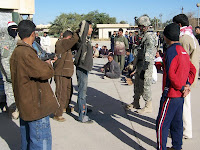 Meanwhile, grassroots efforts are taking place to institutionalize the security gains of recent months, while at the same time work towards sectarian reconciliation in the absence of legislative action at the national level. Neighborhood volunteers, dubbed Critical Infrastructure Guards (GIG's), have been recruited in Sunni neighborhoods to receive rudimentary training, and work alongside the predominantly Shia Iraqi Army and Iraqi Police. They've begun jointly manning checkpoints, and participating in joint patrols of the neighborhoods. The Iraqi soldiers are supposed to assume the role of mentors to these new recruits, and provide them with additional on-the-job training. In return, the new volunteers bring to the table local knowledge of the neighborhoods from whence the come, as well as vastly improved relationships between the security forces and the residents of the communities, who are the friends and family of the new volunteers. As the CIG's gain experience, a certain percentage will be selected to attend the Iraqi Police Academy where they will undergo additional training, and shed their quasi-official status. Under the umbrella of increasingly detached American oversight, the hope is that the program will result in a much improved and professional Iraqi security apparatus.
Friction, however, is inevitable. Aside from the sectarian nature of the arrangement, there is the implicit threat to the status of the Iraqi soldiers who no doubt resent the presence of the volunteers. There is also the very real danger of al Qaeda infiltration of the ranks of new recruits. I had occasion to speak with one of the volunteers who was a Sunni, and a Major in the old army under Saddam. He acknowledged that it will take time to work through many of the problems, but he remained optimistic. He expressed great enthusiasm to be able to serve again in a productive capacity. He clasped my hand, looked me in the eye, and told me with some emotion that none of this would have been possible without the help of the Americans. I just smiled, and said, "Welcome back, sir." He squeezed my hand tighter, and beamed.
The professionalism of the Iraqi Army remains...uneven, and largely a direct reflection of the quality of their leadership. We routinely conduct inspections of Iraqi-manned checkpoints. In the course of one such inspection, an American soldier noticed a ballistic (bulletproof) vest sitting on a chair. When he picked it up, he noticed that it was much lighter than it should have been. To reduce the weight, the Iraqi soldier who owned the vest had replaced the interior ballistic armor plate with ...a book. Now, here is the kicker, and I am not making this up: The book was a medical text on heart trauma.
 Meanwhile, grassroots efforts are taking place to institutionalize the security gains of recent months, while at the same time work towards sectarian reconciliation in the absence of legislative action at the national level. Neighborhood volunteers, dubbed Critical Infrastructure Guards (GIG's), have been recruited in Sunni neighborhoods to receive rudimentary training, and work alongside the predominantly Shia Iraqi Army and Iraqi Police. They've begun jointly manning checkpoints, and participating in joint patrols of the neighborhoods. The Iraqi soldiers are supposed to assume the role of mentors to these new recruits, and provide them with additional on-the-job training. In return, the new volunteers bring to the table local knowledge of the neighborhoods from whence the come, as well as vastly improved relationships between the security forces and the residents of the communities, who are the friends and family of the new volunteers. As the CIG's gain experience, a certain percentage will be selected to attend the Iraqi Police Academy where they will undergo additional training, and shed their quasi-official status. Under the umbrella of increasingly detached American oversight, the hope is that the program will result in a much improved and professional Iraqi security apparatus.
Friction, however, is inevitable. Aside from the sectarian nature of the arrangement, there is the implicit threat to the status of the Iraqi soldiers who no doubt resent the presence of the volunteers. There is also the very real danger of al Qaeda infiltration of the ranks of new recruits. I had occasion to speak with one of the volunteers who was a Sunni, and a Major in the old army under Saddam. He acknowledged that it will take time to work through many of the problems, but he remained optimistic. He expressed great enthusiasm to be able to serve again in a productive capacity. He clasped my hand, looked me in the eye, and told me with some emotion that none of this would have been possible without the help of the Americans. I just smiled, and said, "Welcome back, sir." He squeezed my hand tighter, and beamed.
The professionalism of the Iraqi Army remains...uneven, and largely a direct reflection of the quality of their leadership. We routinely conduct inspections of Iraqi-manned checkpoints. In the course of one such inspection, an American soldier noticed a ballistic (bulletproof) vest sitting on a chair. When he picked it up, he noticed that it was much lighter than it should have been. To reduce the weight, the Iraqi soldier who owned the vest had replaced the interior ballistic armor plate with ...a book. Now, here is the kicker, and I am not making this up: The book was a medical text on heart trauma.
Sunday, November 25, 2007
The power of one
This little story has been sitting on my computer now for several months, as I wasn't quite sure what to do with it. It was relayed to me - with some emotion - by a friend who was there. I've spent a good deal of time at the police station and hospital in question, and am very familiar with the area. However, the events occurred approximately a year before our tour began. I share it here only to shine a small light on the human drama and tragedy behind the all too prosaic crawl across the bottom of the television screen that passes for news.
Haidar was a stocky, rotund fellow. The kind of guy that is immediately likable; a jovial, warm man whose honesty and humor instantly created intimate friendships. He was also a popular police chief, who took his job as a civil servant of the people very seriously.
The police station is located immediately adjacent to the hospital, so the police were regularly checking security and socializing with the hospital staff. On this day, Haidar happened to be talking with staff near the entrance to the hospital's emergency room.
The American soldiers were at the police station when they heard shouting and a commotion coming from the hospital. One of their interpreters turned wide-eyed and said, "It's Haidar. There's a suicide bomber." At that moment, Haidar staggered into the street, towards a protective concrete barrier, clutching a struggling man in a ferocious bear-hug. Before anybody could react, an explosion ripped through the streets.
Haidar knew he was a dead man, but he sacrificed his life to save dozens of patients and staff in that hospital emergency room. He left behind a wife suffering from cancer, and two children. The American soldiers took up a collection amongst themselves in support of his family.
There happened to be a CNN reporter embedded with the American unit, who was a witness to the events. So, the heroics of this lovable, dedicated patriot who sacrificed himself so that others may live were relayed to a global audience as: "Suicide Bomber Kills One."
Haidar was a stocky, rotund fellow. The kind of guy that is immediately likable; a jovial, warm man whose honesty and humor instantly created intimate friendships. He was also a popular police chief, who took his job as a civil servant of the people very seriously.
The police station is located immediately adjacent to the hospital, so the police were regularly checking security and socializing with the hospital staff. On this day, Haidar happened to be talking with staff near the entrance to the hospital's emergency room.
The American soldiers were at the police station when they heard shouting and a commotion coming from the hospital. One of their interpreters turned wide-eyed and said, "It's Haidar. There's a suicide bomber." At that moment, Haidar staggered into the street, towards a protective concrete barrier, clutching a struggling man in a ferocious bear-hug. Before anybody could react, an explosion ripped through the streets.
Haidar knew he was a dead man, but he sacrificed his life to save dozens of patients and staff in that hospital emergency room. He left behind a wife suffering from cancer, and two children. The American soldiers took up a collection amongst themselves in support of his family.
There happened to be a CNN reporter embedded with the American unit, who was a witness to the events. So, the heroics of this lovable, dedicated patriot who sacrificed himself so that others may live were relayed to a global audience as: "Suicide Bomber Kills One."
Monday, November 19, 2007
Mono y mono
Sometimes things happen in war that no amount of training can adequately prepare you for. We were infiltrated. I don't know when it happened. I don't know how long the enemy conducted surveillance before making his move. It is disturbing that he was able to get so close to me before he was identified. A fellow soldier stopped by my door to discuss an upcoming mission, and it was he who alerted me to the interloper in our midst. "Dude. You've got a mouse." So began an epic - and lethal - battle of wits; mono y mono.
 I took an initial inventory of assets at my disposal with which I planned to dispatch my adversary. I immediately dismissed my M-4 rifle, and my M-9 Beretta pistol. Not only would their usage violate the principles of proportionality, but the disciplinary consequences resulting from discharging either weapon in my own room were compelling disincentives. Then my eyes fell upon a toy pellet gun confiscated from a Baghdad market (see the photograph from the October 6 posting on this blog). As the weapon in question is sufficiently powerful to put a hole in an empty Coke can, but silent enough to escape the notice of my chain of command, It appeared the ideal tool.
I perched on my bed with the plastic rifle aimed at a Cheese Nip cracker near the baseboard across the room, and I waited. ..and waited. An electronic bong sound emanated from my laptop computer indicating in incoming email. I turned to identify the sender, and in that brief split-second, the Cheese Nip vanished. Out of frustration I began pulling gear from beneath the bunks, shaking out bags, dragging wall lockers into the middle of the room. I listened intently for the tell-tale sounds of miniature incisors masticating baked crispy snacks. Finally, my piqued ears detect movement from beneath or within Bob's wall locker. I very carefully arranged boxes of soup cans and energy drinks to create a "fatal funnel" through which my foe would have to traverse in order to procure yet another strategically placed Cheese Nip. Again, I wait.
Nothing.
By this time, it was after 1 AM. My sleep deprived brain had reached a point where I was quite simply unable to focus. Even if I did get the creature in my sights, I had no confidence in my ability to hold steady my weapon. I decided on a tactical retreat. Morning would mean a trip to the PX, and an escalation of force: Mouse traps! I shut off the lights and crawled into bed. Alas, my nemesis had other plans.
Just as I was drifting to sleep, I sensed something moving through my hair. The mouse was on my head!! I leapt to my feet, frantically sweeping my scalp with my hands. The mouse jumped to my bed, scurried to the end, bounded to the floor, and disappeared into the rucksacks and duffels piled in the middle of the floor. Sleep was now out of the question. I got to work.
I constructed an elaborate trap using two Cheese Nips, a daub of peanut butter, a piece of string, a Priority Mail box, a can of chili, and a cleaning rod from a gun cleaning kit. It was brilliant! The crackers and peanut butter were attached to the string which was tied around one end of the cleaning rod, which propped up the box. The chili added weight to the box. If the mouse tugged the string, it would dislodge the rod, and bring down the box upon him. For good measure, I loaded the pellet gun and tucked it next to me as I climbed back into bed. Again, I waited.
I saw him out of the corner of my eye as I was answering an email. Such a subtle movement, and oh so silent. There he was...tugging on the cracker attached to the string. But he wasn't strong enough to dislodge the cleaning rod! I slowly raised my rifle, brought the preoccupied rodent into my sights, and gently squeezed the trigger. A plastic Thwack! immediately preceded an aspirated mouse-sized squeak as the creature took a direct hit to his side, flipped over and began kicking wildly at the air. It was a miraculous shot! One in a million! I was exhalant! But before I could cross the room to administer the coup de grace, the animal righted himself and beat a hasty retreat from the battlefield. I couldn't believe it! What was this creature made of that it could withstand such an assault that could puncture a soda can!
 There was little more that I could do. He was to make neither another appearance, nor a sound for the rest of the night. The next morning I journeyed to the PX and purchased mouse traps. I could only hope that I had not dealt a mortal blow, and that he did not seek refuge in some dark corner of my gear only to die there. It could be days before the smell confirmed that fate. I set the traps, and my team and I departed for several days outside the wire.
Upon my return, my victory was confirmed. He lay stiff beneath a sprung overturned trap, his dried blood splashed upon the baseboard.
"The art of war is simple enough. Find out where your enemy is. Get at him as soon as you can. Strike at him as hard as you can and as often as you can, and keep moving on."
 I took an initial inventory of assets at my disposal with which I planned to dispatch my adversary. I immediately dismissed my M-4 rifle, and my M-9 Beretta pistol. Not only would their usage violate the principles of proportionality, but the disciplinary consequences resulting from discharging either weapon in my own room were compelling disincentives. Then my eyes fell upon a toy pellet gun confiscated from a Baghdad market (see the photograph from the October 6 posting on this blog). As the weapon in question is sufficiently powerful to put a hole in an empty Coke can, but silent enough to escape the notice of my chain of command, It appeared the ideal tool.
I perched on my bed with the plastic rifle aimed at a Cheese Nip cracker near the baseboard across the room, and I waited. ..and waited. An electronic bong sound emanated from my laptop computer indicating in incoming email. I turned to identify the sender, and in that brief split-second, the Cheese Nip vanished. Out of frustration I began pulling gear from beneath the bunks, shaking out bags, dragging wall lockers into the middle of the room. I listened intently for the tell-tale sounds of miniature incisors masticating baked crispy snacks. Finally, my piqued ears detect movement from beneath or within Bob's wall locker. I very carefully arranged boxes of soup cans and energy drinks to create a "fatal funnel" through which my foe would have to traverse in order to procure yet another strategically placed Cheese Nip. Again, I wait.
Nothing.
By this time, it was after 1 AM. My sleep deprived brain had reached a point where I was quite simply unable to focus. Even if I did get the creature in my sights, I had no confidence in my ability to hold steady my weapon. I decided on a tactical retreat. Morning would mean a trip to the PX, and an escalation of force: Mouse traps! I shut off the lights and crawled into bed. Alas, my nemesis had other plans.
Just as I was drifting to sleep, I sensed something moving through my hair. The mouse was on my head!! I leapt to my feet, frantically sweeping my scalp with my hands. The mouse jumped to my bed, scurried to the end, bounded to the floor, and disappeared into the rucksacks and duffels piled in the middle of the floor. Sleep was now out of the question. I got to work.
I constructed an elaborate trap using two Cheese Nips, a daub of peanut butter, a piece of string, a Priority Mail box, a can of chili, and a cleaning rod from a gun cleaning kit. It was brilliant! The crackers and peanut butter were attached to the string which was tied around one end of the cleaning rod, which propped up the box. The chili added weight to the box. If the mouse tugged the string, it would dislodge the rod, and bring down the box upon him. For good measure, I loaded the pellet gun and tucked it next to me as I climbed back into bed. Again, I waited.
I saw him out of the corner of my eye as I was answering an email. Such a subtle movement, and oh so silent. There he was...tugging on the cracker attached to the string. But he wasn't strong enough to dislodge the cleaning rod! I slowly raised my rifle, brought the preoccupied rodent into my sights, and gently squeezed the trigger. A plastic Thwack! immediately preceded an aspirated mouse-sized squeak as the creature took a direct hit to his side, flipped over and began kicking wildly at the air. It was a miraculous shot! One in a million! I was exhalant! But before I could cross the room to administer the coup de grace, the animal righted himself and beat a hasty retreat from the battlefield. I couldn't believe it! What was this creature made of that it could withstand such an assault that could puncture a soda can!
 There was little more that I could do. He was to make neither another appearance, nor a sound for the rest of the night. The next morning I journeyed to the PX and purchased mouse traps. I could only hope that I had not dealt a mortal blow, and that he did not seek refuge in some dark corner of my gear only to die there. It could be days before the smell confirmed that fate. I set the traps, and my team and I departed for several days outside the wire.
Upon my return, my victory was confirmed. He lay stiff beneath a sprung overturned trap, his dried blood splashed upon the baseboard.
"The art of war is simple enough. Find out where your enemy is. Get at him as soon as you can. Strike at him as hard as you can and as often as you can, and keep moving on."
- Ulysses S. Grant
Subscribe to:
Posts (Atom)


